Simple Feed
October 13, 2021
Bike handling in your aerobars.
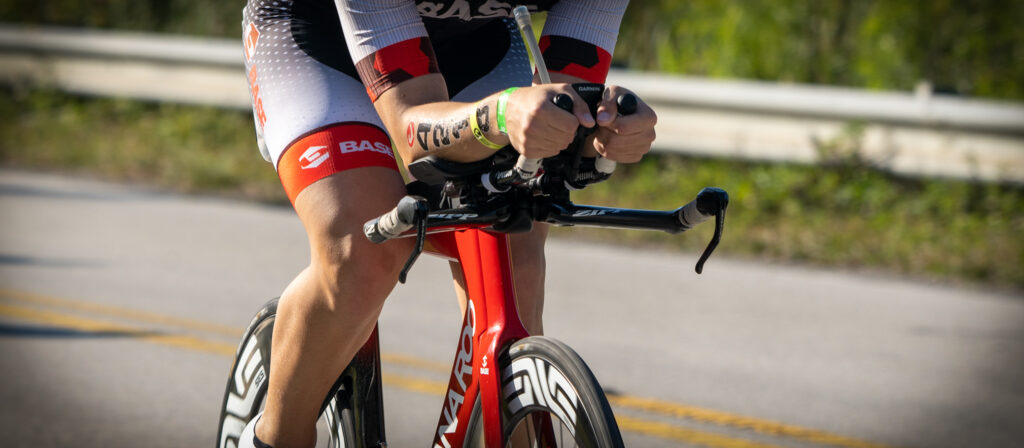
In the 1980s, aerobars were a huge aerodynamic breakthrough. Innovated by triathletes and later adopted by cyclists for time trials, aerobars proved consistent and significant power saving and speed gains in wind tunnel testing. The goal for fast triathlon riding is to stay in an aerodynamic position as much as possible, which means developing the physical ability and riding confidence to stay in your TT bars. Professional triathletes will spend almost an entire Ironman bike in streamline and will tailor their training to adapt their back and body to be most efficient in that aero position. If you watch a non-drafting triathlon you will often observe novice athletes sitting up and giving up speed because they are less comfortable or confident in their aero position.
Consider these key factors for developing aerobar bike skills:
1) Riding in aerobars is a skill that we acquire early as triathlon cyclists. It still requires practice. On a flat road and in an open space it’s not so challenging. But what about descending and climbing? It takes confidence to allow speed on the downhills and experience to know when to sit up on the uphill.
Skill progression: Descend on a lesser grade with few turns and a clear braking path, pedaling in your aerobars if you’re comfortable. As you get more confident try gradually quicker descents. Add some slight curves. As for climbing, stay in aerobars and systematically gear down according to the increasing grade. Practice shifting the appropriate number of gears so that you don’t lose pressure against the pedal and spin out. With experience you can look forward to a hill and anticipate the grade change, shifting before your cadence drops too low and maintaining constant pressure on the pedals. Many athletes sit up too early into a climb. It is beneficial to stay aero as long as you are traveling faster than 12 to 15 mph. If you do sit up, remember to get right back into your aerobars as you crest the hill and accelerate. Shifting well through a rolling course to maintain an even, steady power output takes practice.
2) Predictable, straight-line riding is important. It shows consideration to your fellow competitors and reduces your likelihood of causing an accident. Biking safely becomes more challenging as you deal with eating and drinking, starting your bike computer, grabbing water bottles on the course, and riding in different terrains with wind. You are far less likely to collide with another rider if you are predictable. If you sit and stand, swerve, or brake unexpectedly, you are more likely to cause an accident. Riding consistently also saves energy and produces a smoother power profile with fewer power spikes. Always be conscious of your environment and practice your skills without disrupting your rhythm or your line.
Skill progression: Practice reaching behind you with one hand and then the other while still in the aero position. Touch the back your seat; then progress to taking a water bottle out of a rear bottle cage. Start slowly and focus on not swerving. Reach down between your legs for a water bottle while still pedaling, first seated and then in the aero position. Shoulder check over one shoulder and then the other without swerving. Practice going from base bars to aerobars and back to base bars without surging or wavering offline. Practice going from aerobars to base bars and standing without accelerating or slowing erratically. To really tighten up your ability to hold a straight line, try following a line on the road without inching away from it. Have fun with it! Practice these skills regularly with a friend or teammate and you’ll see your confidence and speed improve.
3) Cornering is important in triathlon. Whether biking in a straight line or around a corner, staying in your aerobars is always faster than standing or sitting up. With practice you can learn to maintain speed while cornering safely. Over-braking robs you of momentum, subsequently requiring more power to re-accelerate, costing you energy.
Skill progression: Find a quiet area with 90 degree turns and practice taking a wider arc through the turn at a low speed with the bike more upright. Reduce the arc of the turn by starting wide, riding tight through the turn and finishing wide. As you grow more confident, gradually increase your speed pedaling through the turn. As you get more familiar with your bike, figure out how fast and tight you can corner while still pedaling without catching your pedal on the ground as the angle of the bike changes. As you grow more confident, go back to slower speeds and practice cornering in your aerobars. Repeat the progression. You can also try cycling on a running track in your aerobars to get comfortable riding turns in a more controlled environment. Finally, take the same cornering progression into downhills, sitting up first, and then moving into the aerobars. Always ride within your skill set and build a gradual progression for yourself. Don’t take unnecessary risk. Some corners are too sharp to pedal and too extreme for aerobars. Make sure that you practice turning in both directions.
Smooth riding is safe and aerodynamic is fast. Create gradual skill progressions and become more confident riding in all circumstances in your aerobars.
Lance Watson, LifeSport head coach, has trained many Ironman, Olympic and age-group champions over the past 30 years. He enjoys coaching athletes of all levels. Contact coach@lifesportcoaching.com to tackle your first Ironman or to perform at a higher level.
October 13, 2021
Why Zone 2 for triathletes?
In triathlon there is a lot of focus on going fast, putting the hammer down, and feeling the burn. While that is a key component to building threshold fitness, those energy systems are often over-targeted, leading to peaking prematurely, injury or burnout.
Zone 2 heart rate or power can generally be equated to a steady aerobic effort. While still conversational, it’s still involves a focus on maintaining rhythm and efficient biomechanics at an even pace. Very generally, it is approximately 85% of your threshold heart rate or power output. Threshold is the hardest output you can sustain for 40 to 60 minutes. Zone 1, alternately, is reserved for recovery and very easy efforts.
The primary benefit of zone 2 training is that it builds aerobic base and endurance. Increased aerobic capacity enhances your ability to sustain a sub threshold pace for a longer period of time. In conjunction with higher intensity efforts, zone 2 is the foundation from which to begin to build threshold fitness. Strong aerobic capacity also allows you to recover more quickly between those higher intensity efforts as you progress into your season. For example, with strong aerobic fitness, you may ultimately be able to perform intervals with a shorter rest in between or be able to perform a higher volume of intervals at the same pace.
By sticking to lower heart rates for progression of running or cycling week after week you will notice that pace will gradually increase at the same heart rate output. This is because you start to build aerobic efficiency. You can log more training hours at a lower heart rate. The result is increased muscular endurance. Muscular durability in the legs is critical for maintaining form and pace in long distance triathlon.
For Ironman triathletes, zone 2 bike training for durations of over four hours are ideal opportunities to practice race specific nutrition. By dialing in your Ironman nutrition protocol, you can test caloric ingestion limits as well as observe your energy availability and muscular ability when running off the bike. In zone 2 you’re able to utilize a higher percentage of fat as fuel versus glycogen. As you go faster the ratio of glycogen consumption increases as well. Glycogen has a more limited fuel supply; without supplementation you can typically store about 1.5 to 2 hours of glycogen in your muscles. In a long distance triathlon, you will always to run a caloric deficit, burning more calories than you can ingest and relying on body fat stores to get you to the finish line. The more you can supplement with quick access energy carbohydrates, the higher percentage of threshold you can race throughout the day. If you are forced to use fat as your primary source of fuel because glycogen is depleted, you’ll have to slow down as fat requires more molecules of oxygen to breakdown than glycogen.
Swimming at a lower intensity also provides the same benefits of increased endurance and the opportunity to build efficiency at a set heart rate or effort. The other benefit of lower intensity swimming is to slow down and emphasize good technique. Improved technique may allow you to match pace with what you previously considered high intensity intervals.
A healthy dose of zone 2 training early in the season ensures proper endurance and an aerobic foundation. This energy system should be maintained throughout the year. Gradually sprinkle in higher training zones (3,4,5) as you get closer to your race. Slow things down to focus on technique, while practicing race specific nutrition at endurance racing specific heart rates.
Lance Watson, LifeSport head coach, has trained many Ironman, Olympic and age-group champions over the past 30 years. He enjoys coaching athletes of all levels. Contact coach@lifesportcoaching.com to tackle your first Ironman or to perform at a higher level.