Simple Feed
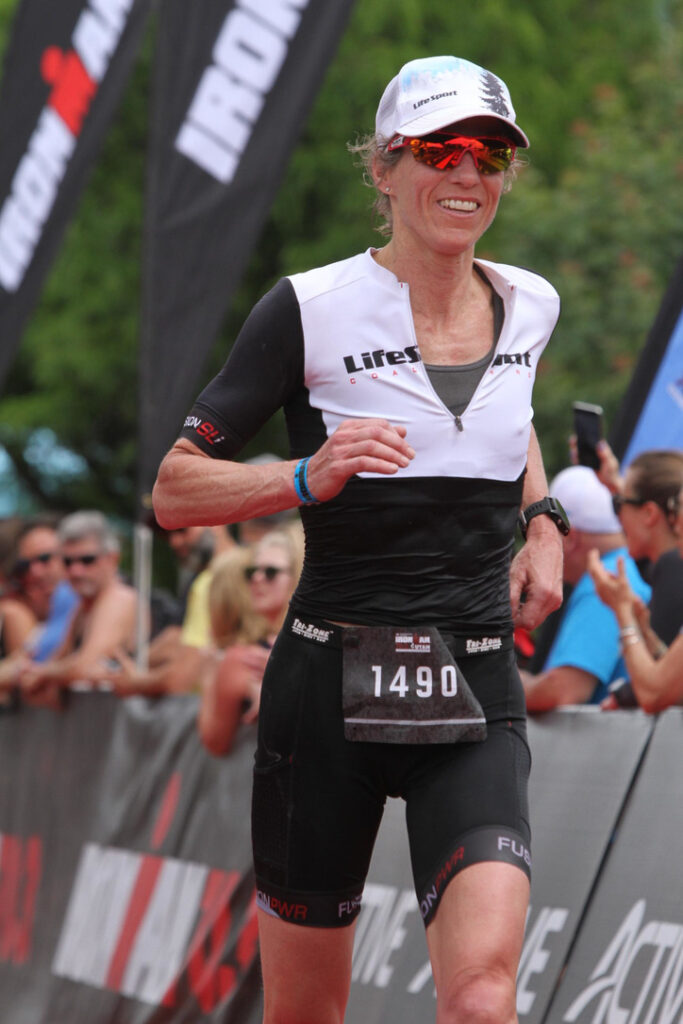
“Courage Micha! Courage! You’re doing GREAT old girl! Stay down, stay tight. COURAGE!”
Mile 31. 1:21 on the bike clock. 250 calories in. Curving downhill, gentle wind out of the southeast. I’m in tight TT position descending Green Springs Drive; Micha-the-Torpedo-TT bike is absolutely flying and I am squeezing every second I can out of this screaming downhill.
As for everyone else at the 70.3 North American Championships last weekend, St. George was my first race in nearly 18 months. Add to the COVID pandemic two injuries and a run-in with cancer that took me out of running for an additional year and Utah was my first 70.3 since Whistler in July 2018. It felt like decades since I’d last lined up in a swim chute; yet here I was yelling at my bike carrying the expectations of myself and others through Utah’s red rocks.
Even when laser-focused on the racing task at hand, there is time to think out there in a 70.3. And plenty of time for gratitude. I know that this has been an impossible, even devastating, year for so many. Yet I’m grateful. I’m grateful for the unexpected gifts of the pandemic. With the return to racing last weekend, these gifts – and their benefits – crystalized for me.
COVID gave us the gift of time.
To train. In a typical training year, athletes focus on 2-3 key events with smaller local or regional races sprinkled in for practice. COVID took away all that. But what initially removed motivation to train became an enormous opportunity. Instead of navigating the boom-bust cycle of train-taper-race-recover, we enjoyed an entire year of uninterrupted, consistent training. Looking back through the last 12 months, I’ve taken fewer than five days off. My power numbers are excellent, my swimming suffered very little from time out of the pool and my running has not only come back but appears to have increased resiliency and consistency. And I’ve seen the same in my athletes. Consistent, focused pandemic-training yielded a walk-away performance at St. George, even as the oldest in my age group. I can’t wait to see my athletes absolutely crush it this year.
To recover. Last April when we went into Lockdown #1, I had booked a surgery date to have my right Achilles totally reconstructed. I’d unsuccessfully tried everything and building any kind of speed or volume was impossible. With hospital procedures delayed and lay-offs compromising my health insurance, surgery was pushed out. This delay unexpectedly gave me time to go through an intentional return-to-run and functional strength regimen. And apparently that was what I needed. On St. George’s challenging run course with 1,267 feet of vertical, I produced my best paced 70.3 run to date.
To learn new skills. Since COVID began, I’ve learned how to use Zwift, Rouvy, Send-in-Blue, YouTube, Hootsuite, Zoom, SquareSpace, WordPress, TabataTimer, Instagram Stories, Venmo and Discord. No, seriously. I’ve also learned to lead engaging strength and bike workouts over Zoom, race on Zwift and Rouvy, and create virtual competitions to inspire and unite athletes across time zones. Why? Because as we pivoted to meet the changing needs of athletes, we had to find new avenues to communicate, connect and inspire. It has made me a better athlete, coach and businesswoman and I have no doubt that my athletes are benefiting from this wider breadth of knowledge and experience.
COVID gave us an opportunity to build community.
The most alarming impact of the pandemic on athletes was not the mourning of delayed race goals and lack of motivation to train, it was that athletes felt very isolated and alone. Unable to attend group workouts, the gym and (in some places) confined to their home, athletes’ MO to use training to socialize was completely eliminated. For athletes without families or living alone, this was particularly devastating, and I worried about far more than their race readiness; I worried about their emotional stability.
So we figured out how to run strength, ride and run workouts via Zoom and Zwift. We had no idea what we were doing at first, but a year later, the LifeSport community is more connected than ever in its history. When people ask me if it’s been lonely training during the pandemic, I laugh and say “no way! I have over a dozen people in my garage every day of the week!”
COVID became an enormous opportunity for athletes to meet each other; train together; get to know individual habits and idiosyncrasies; tease, motivate and inspire one another and – as demonstrated so keenly last weekend – cheer each other on to great race performances. I came back to my car to find over 200 WhatsApp, text and email notifications on my phone. Did I feel that energy out there on the course? You better believe it. And you will too. This is the “build your boathouse” ideal I spoke about in my ChalkTalk in December; the power of community to unconditionally support, empower and inspire. COVID allowed us to build our LifeSport boathouse.
COVID forced us to evaluate our “why?” and to develop mental resilience.
As the pandemic’s shutdown stripped races from the calendar, athletes lost their motivation to train. This continues to surprise me. I love racing to a fault; but racing is not why I train. COVID forced athletes to take a hard look at what motivates them to put in the training hours. Athletes had to work hard to find the “why” in training, to move the internal dialogue from this is something I have to do to something I get to do.
Athletes need to build a mental toolkit to help them navigate the dark moments that inevitably occur during races. We do this in training, capturing the satisfaction of nailing a hard workout, getting out of bed to train when it’s dark and cold, or fearlessly tackling a set that seems impossible on paper. We squirrel away positive mantras and inspiring song lyrics and encouraging feedback from coaches and teammates. These become the tools that we draw on at the top of Snow Canyon’s climb or on the hill at Mile 9. Training through the uncertainty of a pandemic forced us to work a little harder to build that toolkit, making us stronger for the race challenges that lie ahead.
Me? I really missed training with my friends and teammates during the pandemic. I’m a rower with a rower’s expectation that training is a shared endeavor. But alone or with others, I like feeling my body work hard and move fast. I like seeing if I can pull just a little more out of every effort. Every interval of every workout is an opportunity to push a little bit harder, get a little bit faster, find a little bit more speed. If I ever doubted my commitment to a workout, I asked myself “what if this was the one that makes a difference on the hills of St. George?” I want to arrive at every start line knowing there is nothing more I could have done to get there. No stories; no what ifs.
In rowing we often talked about “finding a little more speed.” In a 60-foot, lightweight, carbon-fiber rowing shell manned by eight powerful but fiercely independent women, that was a complicated endeavor. But as I descended Snow Canyon last weekend, hollering at Micha for more COURAGE, it was in that pursuit of speed. And it felt like coming home. So, yes. I’m grateful for the time that the pandemic has given us. To train, to heal, to build community and to build our mental muscle. And you will too. Can’t wait to see you all out there.
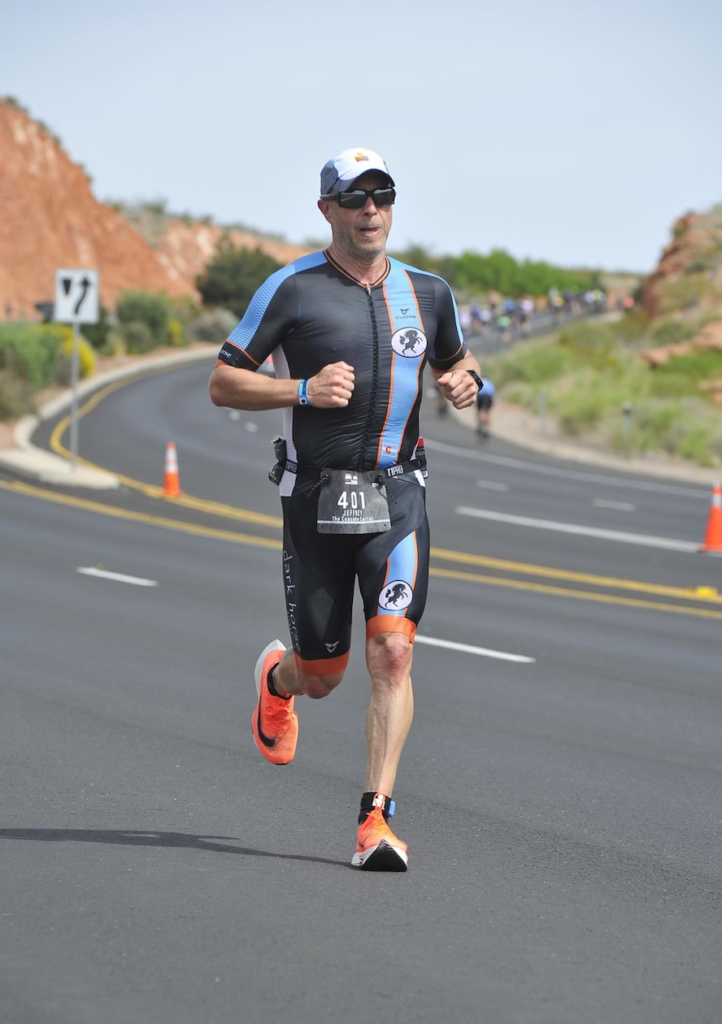
Recently I raced the St George 70.3 and it was terrific to get back to a real, live event after eighteen months. I have been at this a really long time and I feel like while I still have not had a perfect race, this one as close to perfectly executed as I have ever had. I shared some insights on my day with all of my athletes because these are things that they either have heard me say or will hear me say repeatedly as they close in on their own events and so I want to illustrate why these things are so important with my personal real life example.
First and foremost, consistency in training. I went in to this event supremely confident in my fitness. I have been very diligent about hitting all of my workouts and am very consistent in making sure that the QUALITY of my workouts is always VERY high. One of the ways that I do this is by riding on the trainer a LOT. For me with a very time crunched schedule, the trainer lets me compress bike workouts in to a shorter time period without having to deal with stop signs, traffic lights or sketchy drivers. I am a big believer in the power of trainer workouts and while I definitely think road time is invaluable for bike handling and getting comfortable with riding in the wind etc, if you do half or more of your workouts on the trainer you can do pretty amazing things. Everyone has their own limitations of training related to their own life responsibilities but if you can make training consistency a big part of your training in general it will really pay off.
Second, don’t waste a second of your invaluable time or energy sweating over things that are simply out of your control. One of my favorite pastimes has become following race specific Facebook groups in the weeks before an event and watching people melt down over pretty much anything and everything that they have zero ability to control. Will the swim be canceled? Will it be hot? Will it be windy? Will so and so be there? Will they let me do X in transition? Why don’t they have Y at the aid stations? and on and on it goes. You manage yourself and your ability to adapt to situations that arise on race day. Those who stress over all of these other things get themselves in a hole before they even show up. Here’s an inside secret: ALL of those things that people freak out over are exactly the same for everybody else on race day. So spending any time worrying about how it is going to impact you specifically is a particularly bizarre way of viewing the world. When I go to a race, I am completely neutral to all of those things that I cannot control and instead focus exclusively on the things that I can. For example-if the swim is canceled how will I adapt my race plan to make the most of my day? If it is hot how will I ensure that I race to my maximum ability? etc.. You do you and let everyone else expend all of the mental energy on silliness and you will feel infinitely better about things.
Third, dial in your nutrition in training so that it isn’t a mystery on race day. Training your nutrition is just as important as everything else you train. Practice with different kinds of nutrition so that you know exactly what works and then you won’t be surprised on race day.
Fourth, plan your race and race your plan. I knew going in to this race exactly what I was going to do for every segment of this race. As a result I was supremely confident and at ease right up until the moment I stepped in to the water. The proof is in my results:
- Swim: The plan was to ease in to the swim given the cold water. Find a comfortable pace and focus on technique the entire time. When fatigue sets in, double down on technique focus and think cadence. On race morning I did exactly this, I eased in to the swim, focused on technique and moved through the first 900m quickly. I exited the water about a minute slower than I had hoped but faster than I had feared.
- Bike: My goal was to keep my NP at 80%. This is a really hilly course so while I usually want my VI to be <1.03 I knew that wasn’t likely today. I would accept < 1.10. I made sure to not go over my FTP on any of the steep pitches and pushed hard on the descents. In the end my NP was 81% and VI 1.07 a perfect example of racing the plan and I firmly believe this set me up for the run execution that came next.
- For the less initiated, VI or variability index is NP/avg power and is an indication of how much surging is done on hills. Ideally you do not surge anywhere and your NP=avg so VI =1 but this is really hard on a course with any variable terrain. For non-hilly courses, VI < 1.05 is very good. For hilly courses, < 1.1 Surging saps your legs and leaves you fatigued for the run.
- Run: I knew this run course was super hard and not ideal for me but I had broken it up in to sections in my mind and ran it exactly per my plan. First three miles entirely by RPE. At the top of the climb at the beginning of mile 4, lock in HIM race pace. Fly down hills and then at mile 9, get up the hill on the way back as best possible before crushing the three miles downhill to the finish. I had hoped to get under 1:45 for this course and in the end was just over 1:40 so mission accomplished.
What to take away from all of this?
- Success on race day is less about the performance on the day of the event and much more about the quality of prep and planning leading in to it.
- Nutrition can be hard to master but training your nutrition will prepare you to manage it well on race day
- Segmenting courses, especially challenging ones, makes them much more manageable both mentally and physically
- Prepare mentally for eventualities that you can control (flat tires, dropping a water bottle, how you will handle different weather possibilities etc) and BLOCK OUT EVERYTHING ELSE. Because the rest is just noise.