Simple Feed
January 9, 2022
Anti-Gravity Running
Of the three disciplines in triathlon, running is by far the most common cause of injury amongst triathletes and is frequently the cause of prolonged time off training. As a result of this, coaches often look for ways to keep athletes training in order to maintain fitness and even if at all possible, to keep training for their events.
To do this, the injured athlete must strike a fine balance; they need to be able to allow their body the time and rest needed for healing while still being able to put it under the stresses required to result in building strength and fitness.
There are a couple of devices on the market that aim to help runners in this regard. The Lever is a contraption of steel bars, pulleys and elastic cords that is set up on a treadmill and attaches to some tight fitting shorts that are worn while running. The way the system works is that by putting an elastic force pulling up the runner vertically from the treadmill deck they can run with up to 45 lbs of their bodyweight removed.
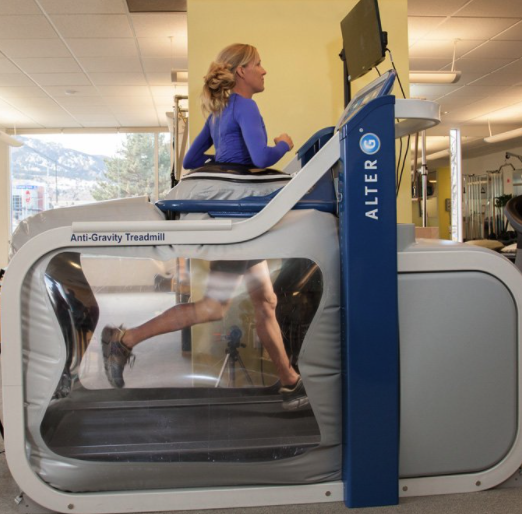
Unlike the Lever Movement that is a temporary device attached to any treadmill, the AlterG is a fully self-contained unit built around a treadmill. Running in the AlterG requires stepping into a skirt that is then zipped in to a large airtight balloon that encloses the entire running deck and pulls up so that it rises to the height of the runner’s waist. The AlterG then inflates this balloon and the pressure of the air in the balloon lifts the runner off the deck of the treadmill reducing their bodyweight.
Both of these devices aim to allow runners to continue running with injury by allowing them to run at a lower effective body weight. The question for coaches to consider before integrating either of these devices in to an athlete’s program is, do they work? That is to say, does using either of these devices actually allow for athletes to exercise in a manner that promotes both injury rehabilitation and improved fitness?
There is a fairly good body of evidence that shows that the AlterG at least does exactly what it says it does in terms of reducing ground force interactions for runners who use it to run with reduced body weight. Basically the research has shown that when runners use the AlterG to run with a reduced body weight they are in fact seeing ground forces that are associated with that lower running weight.
In one very small three subject study using the Lever apparatus, similar results were shown so at least as a proof of concept, the Lever also appears to reduce ground force by giving runners a weight reduction.
Other studies have shown that with the reductions in ground forces there are related reductions in contact forces on the bones of the lower limbs as well as decreased contraction forces of the leg muscles all the way up to the glutei. Once again this makes perfect sense, if you are running with less weight you need to exert less muscular force to propel yourself forward and will sustain less impact forces to your skeleton upon landing.
So the first part of the question has some science to back up the theory-running with one of these anti-gravity devices will allow you to run while exerting a significantly lower physical toll on your body thus allowing an injured runner to potentially continue to run.
But what about the second half of the question? Is running in this way beneficial to fitness and to training? Several studies have looked at this question with respect to the AlterG though to date there are none for the Lever.
The most important finding related to fitness and training quality when running in an AlterG is the fact that once you exceed a 20% weight reduction, you start to see a significant decrease in the metabolic needs for running and an increase in the time to exhaustion. Again, this isn’t hard to understand. If you are exerting yourself less because of a lower body weight, you will be metabolically less active and have a longer duration of activity before exhaustion.
Put another way by different authors, when running up to 9mph, a 25% reduction in body weight requires a 3 mph increase in speed to run at the same VO2 when running at full body weight. Several authors have found that similar to increasing running speed, another way to improve training benefits while using weight reduction is to increase the incline of the TM, something that can be done with both the AlterG and the Lever.
So it appears that it is possible to get a near normal training benefit when using these devices but I think it is fair to ask, is an injured runner going to be able to do these modifications? If you are injured in some way after all, how likely is it that you are going to be able to increase your run speed by 3mph or run at a significant incline? It doesn’t mean that it can’t be done, only that this needs to be considered. Also, if you are running on these devices at 20% weight reduction where your metabolic needs are pretty much equivalent to running with no weight reduction then do you need the weight reduction at all?
A much less expensive alternative to these devices and one that also has been studied is deep water running. A couple of pretty good studies have looked at the benefits of deep water running and shown that if done properly, this activity can confer some real training benefits while exposing the body to essentially zero ground forces and allow for maximal recovery. In the end, water running is a very viable strategy for the injured runner as it will allow for higher intensity without any stress on the skeleton, tendons or muscles that might be injured.
Clearly both the AlterG and the Lever Movement device offer anti-gravity options for injured runners to rehabilitate themselves in a manner that allows them to continue running while decreasing stress to their injured selves. The efficacy of that running is going to be significantly diminished though unless they can really increase their pace or the incline that they run at and given the injury these may not be possible. When factoring in the cost and inconvenience of both of these modalities, deep water running begins to look increasingly attractive and a much more viable alternative.
Train hard, train healthy.
Jeff Sankoff is a LifeSport Performance Coach, the TriDoc, an emergency physician, triathlete and USAT and Ironman University certified triathlon coach. He works with athletes of all backgrounds and abilities. To learn more about working with Jeff to achieve your triathlon goals, please contact office@lifesportcoaching.com and learn more about Jeff on his coaching page.
December 30, 2021
How long should my long run be?
As first seen in Triathlete magazine.
The long run isn’t sexy, but it is a staple of every triathlete’s training plan. If speed work is a Ferrari, then the long run is a diesel, one-ton pickup truck. It’s the steady dependable workhouse that will help you go the distance. But despite the importance of this staple workout, most triathletes don’t know the answer to a basic question: How long should my long run be?
As part of a consistent triathlon training program, the long run helps build stamina, develop run economy, improve muscular endurance, and even increase speed. The act of running for an extended period of time increases the strength of primary muscles like quads, hamstrings, calves, and hip flexors. And, this type of steady, aerobic activity is crucial to the development of capillaries, the small blood vessels that deliver oxygen to the muscles, and increasing mitochondria, which use oxygen to transform carbs and fat into energy.
Beyond the physiological benefits, triathletes can also use their long run as an opportunity to work on form and technique, practice race day nutrition, and develop mental fortitude. Running for longer periods of time can lead to increased confidence in your ability to cover the miles during a race.
The physiology of the long run
Lance Watson of Lifesport Coaching has been a triathlon coach for over 30 years and has trained Olympic gold medalists and over 20 Ironman champions. He explains how endurance training can increase heart size and total blood volume.
“Endurance training can increase the number of capillaries in the muscles, allowing for better delivery of blood. It also increases the concentration of red blood cells,” he said. “The size and number of mitochondria increase with training, as well as the oxidative enzymes within.”
Mitochondria are important for endurance athletes, because these cellular powerhouses supply energy to your muscles during aerobic activity. Long runs can also alter your muscle structure.
“Endurance running can increase the size and efficiency of slow-twitch muscle fibers,” Watson said. “Also, endurance running can result in a shift towards fat burning at sub-maximal exercise intensity.”
Running off the bike is like running the back half of a longer race, said Watson—something you need to practice for both long-distance running and triathlon races. “For instance, running 10 kilometers off the bike is similar to running the final 10 kilometers of a half-marathon. You need the endurance and resilience to be able to maintain form when starting the run leg with fatigue in your muscles.”
That type of muscular endurance and durability will be a huge help during the later stages of a race, especially one that can last 8-12 hours. But the confidence that comes from running long distances is just as valuable.
“Learning how to be process-oriented and engaged with run economy and technique, as you gradually fatigue during a long run, has tremendous mental crossover to race day as well,” he said.
Common long run mistakes
But there is a right way and a wrong way to do the long run. The most common mistakes include ramping up mileage too quickly and doing too much running on hard surfaces, which can put athletes at risk of overuse injuries like fractures or tendonitis.
“Another common triathlete mistake is always placing the long run on a Sunday after a long ride on Saturday and always running tired,” Watson said. While there are benefits to doing some running fatigued to mimic race fatigue, “you can make greater progress in your endurance running if you hit the long run fresh, some of the time.”
The long run doesn’t always have to be a slow slog in zone 2. Adding a bit of intensity, elevation gain, and even switching up the running surface can add variety and has numerous benefits.
“There is value to steady, sustained, aerobic rhythm on a flat surface, which reinforces run economy,” Watson said. “I will often prescribe one-half to two-thirds of the run on a flat surface and then finish on rolling to hilly terrain to mix up muscle angles. Adding in some elevation on different run surfaces helps to recruit different muscles, which will build strength and help prevent overuse injuries from repetitive pounding on hard pavement. You can use this technique to simulate the terrain of your long run at your upcoming race by aiming for similar elevation gain.”
Another one of Watson’s favorite variations is the progression run that builds in pace and heart rate by thirds. This type of run has the two-fold benefit of teaching pacing control and running well on tired legs.
“While the long run is often a place for sustained aerobic effort, it doesn’t always have to be that way,” he said. “Doing a progression run, where an athlete builds in effort, gradually moving into higher heart rate zones, helps simulate the feelings of race day fatigue, teaches pacing, and provides variety and mental stimulation.”
How long should my long run be?
Like many coaches, Watson prescribes long runs that are based off duration, not distance. Ultimately, the duration and intensity of your long run will be impacted by what event you’re racing; training for an Ironman will require much different preparation than a sprint triathlon.
| RACE DISTANCE | LONG RUN DISTANCE |
| Sprint | 25-50 minutes |
| Olympic | 60-90 minutes |
| 70.3 | 75-120 minutes |
| Iron | 90-180 minutes |
Watson often prescribes the longest run in a training cycle between three to six weeks out from a big race.
“If an athlete is planning to finish a longer event for the first time, they’re going to need to focus on simply building enough volume to tackle the distance, whereas the experienced or competitive Ironman can build to max duration a little earlier and then have a shorter, higher intensity, peaking phase.”
Essentially, the less experienced triathlete will build volume in a linear fashion, with intermittent recovery weeks, gradually increasing until it’s time to taper. The more experienced triathlete, who’s looking to go faster, may do their longest run further out from race day, because he or she will be increasing intensity and reducing volume closer to the key event.
Do you need to run the full distance before race day?
A common debate among athletes is whether or not to run the full distance, in training, that you will be covering during the triathlon itself. Watson says the speed and ability of the athlete will determine the answer to this question.about:blank
“For example, a professional athlete may cover a marathon during a three-hour endurance run. But, the cost of running more than three hours typically outweighs the benefit, meaning that the recovery required is detrimental to subsequent training and can create gaps in your progression,” he said. “I’ve observed athletes doing mileage-based progressions for marathons, and they might be out there five hours trying to hit 22 miles, just three weeks before their marathon. That’s a formula for overtraining and injury.”
If Watson has an athlete who will complete their Ironman marathon in more than 4.5 hours, he will have them do several, non-stop long runs between 90 minutes to 2.5 hours. Then, they will also do one to two long runs, with walking breaks, that exceed three hours. “The walking breaks mimic aid stations,” he said. “Also, the micro breaks have the benefit of less cost to muscle breakdown.”
Long run workouts
Two-Hour Aerobic Run With Elevation
- 75 minutes flat
- 45 minutes rolling to hilly
- Heart rate should stay in zone 2, but may climb into low zone 3 during hilly sections.
Two-Hour Progressive Build Run
- 10 minutes in zone 1
- 30 minutes in zone 2
- 30 minutes in zone 3
- 30 minutes in low zone 4
- 5 minutes easy
LifeSport head coach Lance Watson has coached a number of Ironman, Olympic and age-group Champions over the past 30 years. He enjoys coaching athletes of all levels. Join Lance to tackle your first triathlon or perform at a higher level.